
You are not imagining it. You are not overreacting. That extra hair in the drain, the slightly wider forehead in photos, the hairline that looks a little different from two years ago it is real. And if you are 25 and dealing with it, it probably feels like it is happening way too soon.
The truth is, it is more common than anyone talks about. But common does not mean you have to accept it without understanding it first.
This is not another article that just tells you to “see a dermatologist.” This one actually walks you through what is happening, why it happens young, what actually works, and what most guys waste money on before figuring it out.
Table of Contents
ToggleQuick Answer
Hair loss at 25 is most commonly caused by male pattern baldness, also called androgenetic alopecia. It is driven by genetics and a hormone called DHT. Early signs include a receding hairline or thinning at the crown. The earlier you catch it and take action, the better your chances of slowing or stopping it. Treatments like minoxidil and finasteride have strong clinical evidence behind them.
What Is Hair Loss at 25?
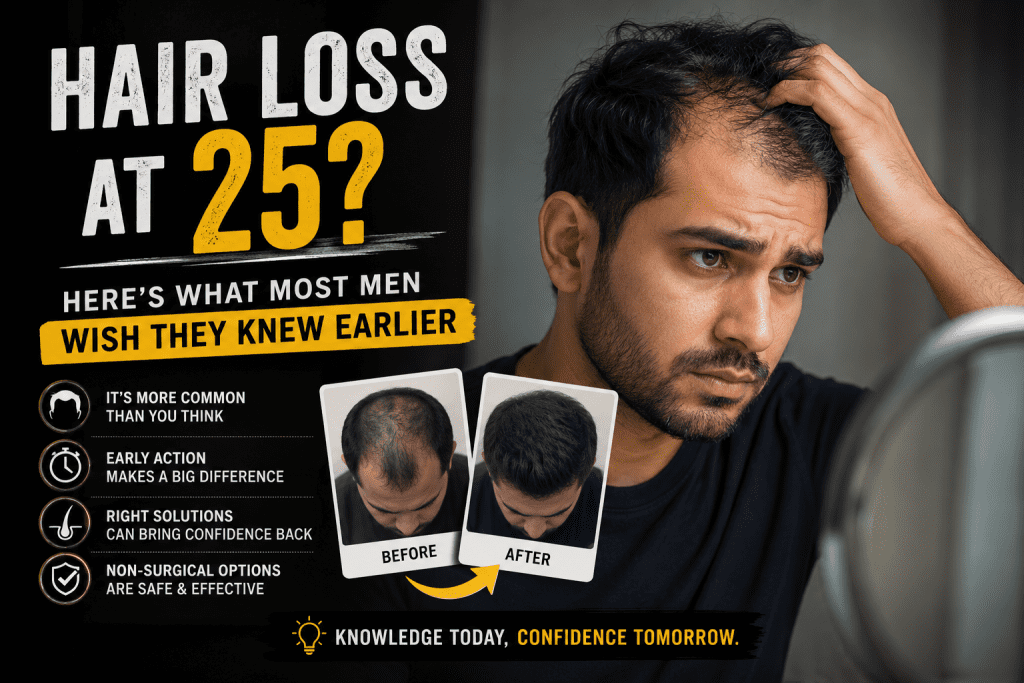
Hair loss this early in life usually means male pattern baldness is starting. This is not about stress or diet or washing your hair wrong. It is a genetic condition where hair follicles are sensitive to dihydrotestosterone, which is a byproduct of testosterone.
Over time, DHT shrinks those follicles. Hair grows back thinner, shorter, and weaker with each cycle. Eventually some follicles stop producing hair altogether.
The process starts years before you actually notice it. By the time you see a receding hairline or thinning crown, it has likely been happening quietly for a while.
A lot of men in their mid-20s dismiss it as shedding or assume it will stop on its own. Most of the time it does not.
Why Does It Happen So Early?
Most people assume hair loss is for older men. But male pattern baldness can start as early as the late teens or early 20s if you have the genetics for it.
Here is what actually drives it:
Genetics. This is the biggest factor. If your father, maternal grandfather, or uncles experienced early hair loss, your chances increase significantly. It is not just about your dad’s side, contrary to popular belief.
DHT sensitivity. Some men’s follicles react more aggressively to DHT than others. That sensitivity is inherited.
Testosterone levels. Higher testosterone does not automatically mean more hair loss. It is the conversion to DHT and how your follicles respond to it that matters.
Stress and nutrition. These can accelerate shedding and cause a separate condition called telogen effluvium, but they are usually not the root cause of pattern baldness.
Knowing the difference between pattern baldness and other types of hair loss matters a lot before you start any treatment.
The Stages of Male Pattern Baldness (The Norwood Scale)
The Norwood Hamilton Scale is how doctors classify male hair loss progression. It goes from Stage 1 (no visible loss) to Stage 7 (significant baldness).
Most men in their mid-20s who notice early signs are at Stage 2 or Stage 3. This is actually the best time to act because the follicles are still active and treatable.
| Norwood Stage | What It Looks Like | Common Age of Onset |
|---|---|---|
| Stage 1 | No visible recession | Teens to 20s |
| Stage 2 | Slight temples recession | Early 20s |
| Stage 3 | Deeper temple recession | Mid-20s to 30s |
| Stage 4 | Crown thinning begins | Late 20s to 30s |
| Stage 5 | Temple and crown merging | 30s |
| Stage 6 | Large bald area forming | 30s to 40s |
| Stage 7 | Only sides and back remain | 40s+ |
If you are reading this at 25 and at Stage 2 or 3, you are in a good position to do something about it.
What Actually Works (And What Doesn't)
This is the part most blog posts gloss over. Let’s be direct.
Minoxidil (Rogaine) Minoxidil is one of only two FDA-approved treatments for male hair loss. It comes in liquid or foam and is applied directly to the scalp.
It works by extending the hair growth phase and increasing blood flow to follicles. It does not block DHT, which means it addresses the symptom more than the cause. But for a lot of men, it significantly slows loss and even regrows some hair.
You need to use it consistently. If you stop, any regrowth you gained will shed within a few months.
Finasteride (Propecia) Finasteride is the other FDA-approved option. It works differently. It blocks the enzyme that converts testosterone to DHT, which means it hits the actual cause of pattern baldness.
Clinical studies show it stops progression in over 80% of men and promotes regrowth in a meaningful percentage. It is taken as a daily oral pill.
There are potential side effects, mainly sexual in nature, that affect a small percentage of men. This is something to discuss with a doctor. But for most men who use it, it is well-tolerated and effective.
The Combination Approach Many dermatologists recommend using both minoxidil and finasteride together. The logic is simple: finasteride slows the loss while minoxidil stimulates regrowth. Together they work better than either does alone.
Low-Level Laser Therapy (LLLT) There are FDA-cleared devices like laser caps and combs that use low-level light to stimulate follicles. The evidence is moderate, not strong, but some men find it helps as an add-on to other treatments.
What Does Not Work Shampoos marketed as “hair growth” shampoos. Biotin supplements if you are not deficient. Essential oils. Scalp massages alone. Expensive “clinics” that promise miracles. These are not cures and most have very little evidence behind them.
Common Mistakes Men Make
Waiting Too Long This is the biggest one. A lot of guys spend two or three years thinking it will stop or hoping it gets better. Hair follicles that have been dormant too long do not always respond to treatment. Early action gives you far more options.
Self-Diagnosing Without a Professional Not all hair loss is androgenetic alopecia. Alopecia areata, telogen effluvium, scalp infections, and thyroid issues can all cause shedding. Getting the wrong diagnosis means treating the wrong problem.
Buying Everything From Instagram Ads The hair loss supplement market is enormous and mostly unregulated. Brands spend more on marketing than on research. A ₹2,000 monthly supplement with no clinical data is not the same as an FDA-approved treatment.
Inconsistent Use of Treatments Minoxidil and finasteride are maintenance treatments, not quick fixes. Missing days or quitting too early because you do not see instant results is a common mistake. Most people see meaningful results at the 3 to 6 month mark.
Ignoring the Emotional Side Hair loss at a young age hits differently. It affects confidence, self-image, and how you show up socially. Ignoring those feelings does not help. Addressing them, whether through therapy, community, or just talking to someone honestly, is part of the process.
Non-Surgical Hair Restoration: An Option Worth Knowing
Not everyone wants to take medication. Some men have already progressed beyond what medication can reverse. This is where non-surgical hair replacement becomes relevant.
Non-surgical systems use real human hair bonded to a base that matches your scalp. They look natural, feel natural, and give you a full head of hair without any surgery or recovery time.
Studios like Antidot Hair Studio in Hyderabad specialize in these systems. They customize the hair density, color, and hairline to suit your face and preferences. Men who use these often say the results changed how they felt walking into a room.
It is not for everyone, but it is a legitimate option that many men in their 20s and 30s are choosing, especially when they want results now rather than waiting six months to see if medication works.
Real-Life Example
Ravi was 26 when he noticed his hairline had visibly changed in photographs. He assumed it was stress from work. He bought a DHT-blocking shampoo and a biotin supplement from Amazon and tried them for a few months. Nothing changed.
He finally saw a dermatologist who confirmed it was androgenetic alopecia at Stage 3. He started finasteride and minoxidil together.
By the end of month four, shedding had significantly slowed. By month eight, he had noticeable regrowth at the temples.
He still says the biggest mistake was the six months he spent on products that were not going to work.
Expert Tips
Start tracking early. Take photos of your hairline every two months under the same lighting. Progression that seems invisible day to day becomes obvious over six months.
See a dermatologist, not just a general physician. Dermatologists who specialize in trichology (hair and scalp health) will give you better guidance.
If you are considering finasteride, ask about blood tests first. Checking baseline hormone levels gives you a reference point.
Do not combine every supplement you read about. More is not better with hair treatments. Stick to what has actual evidence.
Look into PRP therapy if you want to supplement clinical treatments. Platelet rich plasma injections have growing evidence for stimulating dormant follicles, though they are not cheap.
Frequently Asked Questions
Can hair loss at 25 be reversed?
It depends on how early you catch it and what type it is. Pattern baldness cannot be fully reversed in most cases, but early treatment can significantly slow progression and regrow hair in thinning areas. Non-surgical options can restore the appearance of a full head of hair without reversal.
Is hair loss at 25 normal?
Yes. Studies suggest roughly 25 percent of men begin experiencing male pattern baldness before the age of 21. By 25, it is quite common. Normal does not mean untreatable though.
Does stress cause permanent hair loss?
Stress-related hair loss, called telogen effluvium, is usually temporary. Pattern baldness is permanent if left untreated but is not caused by stress.
How long does minoxidil take to work?
Most men see results between 3 to 6 months of consistent daily use. It needs to be used indefinitely to maintain results.
Is finasteride safe for men in their 20s?
It has been used safely by millions of men since FDA approval in 1997. Side effects are real but occur in a minority of users. A doctor can help you evaluate whether the benefits outweigh the risks for your situation.
Can diet improve hair growth?
Diet can support hair health but it is not a treatment for pattern baldness. Iron deficiency, zinc deficiency, and very low calorie diets can worsen shedding. A balanced diet matters but it will not stop genetic hair loss.
What is the difference between hair shedding and hair loss?
Shedding is normal. Losing 50 to 100 hairs per day is part of the natural hair cycle. Hair loss refers to follicles that stop producing hair altogether, which results in visible thinning or bald spots.
Are hair transplants a good option at 25?
Most surgeons recommend waiting until hair loss has stabilized before doing a transplant. At 25, loss is often still progressing, which means a transplant done now may look uneven later. Non-surgical alternatives are often recommended first at this age.
Key Takeaways
- Hair loss at 25 is common and most often caused by male pattern baldness driven by DHT and genetics
- The earlier you start treatment, the more options you have and the better your results tend to be
- Minoxidil and finasteride are the two FDA-approved treatments with the strongest evidence
- Non-surgical hair replacement is a credible, immediate option for men who want results without waiting
- Avoid wasting time and money on supplements and shampoos that have no clinical backing
- Seeing a dermatologist is the most important first step
Conclusion
Finding out you are losing hair at 25 is not a small thing. It affects how you feel about yourself, and that is completely valid. What matters is not letting that feeling push you toward panic buying or ignoring the problem hoping it goes away.
You have real options. The evidence-based treatments work. Non-surgical solutions have come a long way and look genuinely natural today. And the earlier you move on this, the more control you actually have over the outcome.
You are not too young to address this. If anything, being 25 means you have caught it early enough to do something meaningful about it.
Ready to Take the Next Step?
If you are in Hyderabad and want to explore your options, whether that is understanding your hair loss better or looking at non-surgical hair restoration, Antidot Hair Studio can help. They work with men at all stages of hair loss and offer personalized consultations to figure out what will actually work for you.
Book a free consultation today and get a clear picture of where you stand and what your options are.